90%1
of businesses have no clear, documented roadmap for PQC migration.
TRUSTED COMPUTING GROUP, STATE OF PQC READINESS 2025
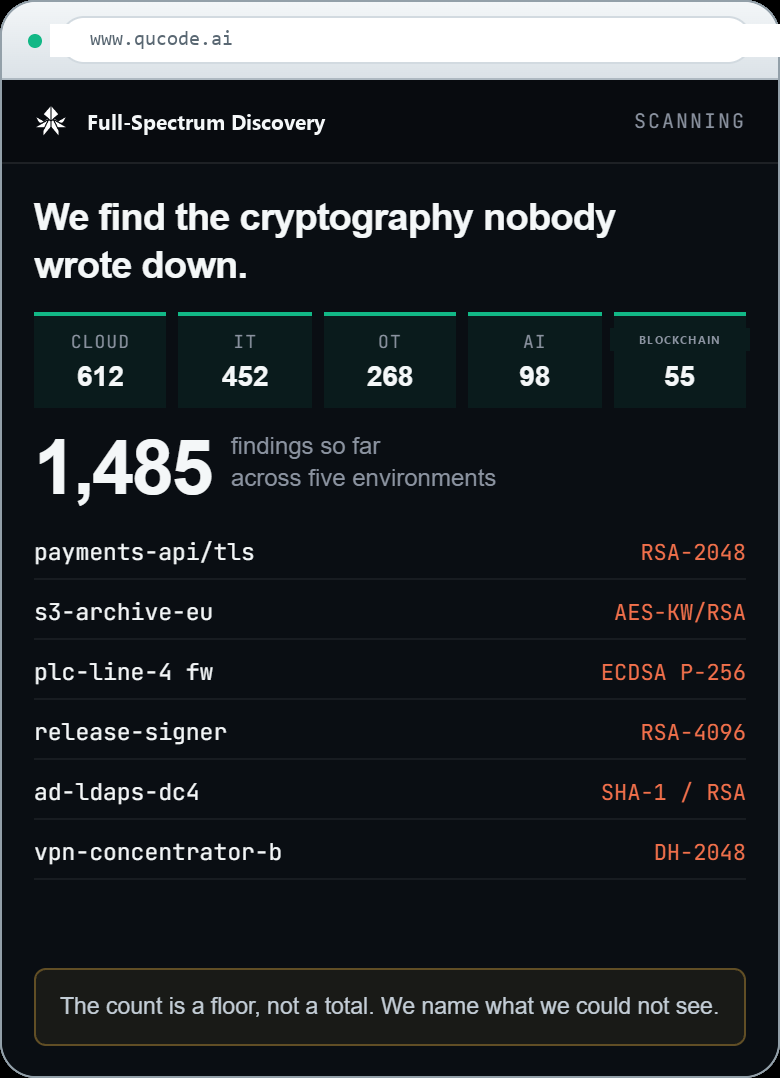
Your scanners tell you what's broken. QuCode tells you whose job it is to fix it, and gives you the proof. It runs its own scans across all five surfaces, brings in the results from the scanners you already have, and turns everything into one ranked inventory of quantum-vulnerable cryptography, yours and your suppliers', each with an owner.
of businesses have no clear, documented roadmap for PQC migration.
of cybersecurity professionals say their current cryptographic libraries and HSMs are unequipped to handle PQC integration.
average enterprise quantum-safe readiness score.
Two phases of every migration depend on your suppliers: finding what is there, and replacing the last systems. Your migration finishes when your vendors finish, yet most organizations measure vendor readiness with a questionnaire the vendor fills in about itself. QuCode gives you the evidence to show where the delay really sits.
Illustrative. Every finding in a real report names the software, the algorithm, where it runs and an exposure score.
The last systems in any migration are waiting on suppliers to ship PQC-ready products. Your finish date is set by whichever vendor finishes last.
A questionnaire records what a vendor believes about its own product. A scan shows the algorithm actually running in the software you deployed.
Outsourcing your cloud, code signing or digital-asset custody moves the work, not the questions. When the regulator asks, you need evidence from what is actually running, not a vendor's promise.
Which vendor products use quantum-vulnerable cryptography is information your vendors hold, not your team. A scan of what you have deployed puts that answer back in your hands.
A partial view produces a partial roadmap, and vendor-supplied technology sits in every one of these surfaces.
The services and systems you rent rather than own, plus the crypto configuration you inherited with them.
Internal technology: computers, networks, certificates, identity, and the third-party software running on them.
Operational technology: physical devices and their embedded firmware, from hardware security modules (HSMs) to payment terminals, almost all vendor-supplied.
Model endpoints and training pipelines. Almost nobody else is looking here yet.
Blockchains, bridges, digital-asset custody and validator keys, where signatures already written can never be re-signed.
Run discovery hosted by us, in your own cloud account, or entirely inside your systems. You choose where your data sits.
QuCode runs its own read-only scans of source and compiled code, container images, certificate stores, infrastructure configuration and software bills of materials (SBOMs), and brings in the results from scanners you already own. No endpoint agents.
Findings from Cloud, IT, OT, AI and Blockchain come together in one inventory instead of five separate tool reports, covering your own software and what your vendors supplied.
Each finding is scored by how exposed it is and how critical the system is, then assigned to your team or a supplier: what exists, where it runs, which algorithm it uses, and who has to fix it.
One ranked list of quantum-vulnerable cryptography across your own systems and the third-party products inside them. Every finding names the software, the algorithm, where it runs, how exposed it is and who needs to act.
“Can management show what is exposed, how long it matters, who owns it, what it will cost, and how progress is evidenced?”
That is the question your board will ask. The QuCode report answers the first three. QuTrust tracks the cost and the progress.
Scroll to see every column
Vendor names in the sample are placeholders. Scores weigh how sensitive the data is, how critical the system is and how long it stays exposed.
The Crypto-Agility Lifecycle Model has eight phases. QuCode leads discovery and inventory, supports governance and pilot testing, and returns in phase 07 to rescan continuously, because new cryptography keeps arriving after you start. From risk assessment onward, QuTrust keeps your action plan and roadmap current, building crypto-agility into your cyber program.
Scroll to see every product column
Elevating AI and quantum risk to executive and board level, naming accountable owners and defining roles before any technical work begins.
Finding every instance of quantum-vulnerable cryptography across code, network protocols, certificates and third-party dependencies.
Turning the inventory into a risk-ranked migration plan based on how sensitive the data is, how critical the system is and how long it stays exposed.
Proving post-quantum and hybrid algorithms against real protocols and infrastructure before anything reaches production.
Moving TLS, VPN and other key-exchange protocols to quantum-resistant key establishment (ML-KEM).
Moving code-signing, certificate authorities and authentication protocols to post-quantum signatures (ML-DSA, SLH-DSA).
Finishing the older and supplier-dependent systems left until last, while continuous rescanning routes newly introduced cryptography back into discovery.
Making the ability to swap algorithms again a standing capability, as standards, infrastructure and threats keep moving.
Phases 02 and 07 are the ones you do not fully control, because both depend on suppliers. Discovery has a fixed scope and a clear end. Everything after it depends on what the scan finds, so it is scoped for each organization.
Where a tool cannot look, it reports nothing, and that silence looks exactly like a clean result.
Scroll to see all five surfaces
Vendors anonymized, coverage from published documentation. Blockchain covers ledgers, bridges and custody.
Discovery never modifies anything, rotates keys or touches production traffic. Every tier runs the same read-only discovery, reads the scanner results you already have, and produces a report that belongs to you alone. What changes is who operates it and where it runs.
We operate QuCode in the region you choose. Nothing to stand up, and data residency stays inside that region.
Deployed into your own cloud account, inside your network boundary, with your keys and your identity provider.
Runs entirely on your infrastructure. Nothing depends on an outside connection, and nothing about your systems leaves your network.
QuCode is not offered air-gapped. For environments with no network connection at all, QuTrust runs fully offline and never connects back to us.
Yes, it scans, and that is step one. A scanner stops at a list of findings. QuCode keeps going: it brings in results from the scanners you already own, combines everything into one inventory, assigns each finding to your team or a supplier, ranks it by risk, maps it to the NIST post-quantum standards and exports it for audit. Then it keeps rescanning, so the inventory stays current as your QuTrust roadmap moves forward.
We scope a discovery scan in one working session with your security and third-party risk leads, and send the sample Quantum Exposure Report beforehand so you know what you are scoping. No homework for your team.
Pick a slot that suits you. Our calendar is open, so there is nothing to arrange by email first.
Opens our booking page in a new tab. Prefer to ask a question first? Contact us.
Ask a question, see the product working on realistic findings, or just follow the regulation as it lands. Everything is handled by the team that runs the scans, not a call center.
Tell us what you are looking for and which products are in scope. A named engineer replies, usually within one working day.
Opens our contact form in a new tab.
When you are ready to act, expand into QuTrust, your system of record for the migration: a living action plan and roadmap for your multi-year migration that builds crypto-agility into the cyber program you already run, with evidence your board, auditors and regulators will accept. QuTrust can also run fully offline. Through 2026, QuCode and QuTrust come together for the price of one.